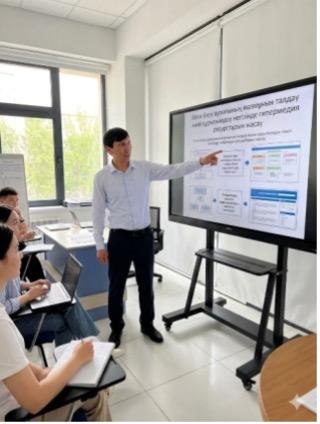
On April 15, 2026, at 10:00 a.m., B.D. Orazov, Master of Science and Senior Lecturer of the Department of Mathematics and Physics, conducted a seminar
2026-06-03
On April 15, 2026, at 10:00 a.m., B.D. Orazov, Master of Science and Senior Lecturer of the Department of Mathematics and Physics, conducted a seminar in Room 204 on the topic “Development of Hypermedia Resources Based on the Analysis and Structuring of Educational Content.”
In the modern educational system, the effective presentation of information is one of the key challenges. In this regard, the development of hypermedia resources based on the analysis and logical structuring of educational content has become increasingly important. Hypermedia resources integrate text, images, video materials, animations, audio content, and hyperlinks into a unified system, enabling learners to acquire educational material in a deeper and more visual manner. During the development of such resources, the content of an academic discipline is analyzed, key concepts are identified, and the relationships between them are established. As a result, learners are provided with the opportunity to study educational material through individualized learning pathways and gain rapid access to additional information sources.
As an example, a hypermedia resource on the topic “Fundamental Principles of the Molecular Kinetic Theory” was presented. The main page of the resource contains the definition of molecular kinetic theory. The following components are interconnected through hyperlinks:
textual information: fundamental principles of the theory;
animation: visualization of the random motion of gas molecules;
video material: an experiment demonstrating Brownian motion;
interactive model: observation of changes in molecular velocity as temperature varies;
problem-solving section: exercises related to the ideal gas equation of state;
assessment section: test tasks designed to evaluate learners’ understanding of the topic.
For instance, when a learner selects the concept of “Temperature,” they can access textual information explaining its physical meaning, an animation illustrating the kinetic energy of molecular motion, and a video demonstrating the corresponding experiment. Thus, the hypermedia resource facilitates a systematic, visual, and interactive approach to mastering educational content.